Risk · R:R · sizing
Risk, R:R and position size: the whole 1:1 system
Twenty points of stop, twenty of target, one NQ mini, two trades a day. Every number I use, why the ratio everyone laughs at works, and a calculator so you can check it against your own win rate.
Some links on this page are affiliate links. If you sign up through them with code ABHI, you get a discount and I get a commission. It doesn't change what I've written here.
The comment I get on every clip
"Bro, 1:1? That's negative R:R." Sometimes with a laughing emoji. I understand where it comes from: every course teaches that you need 1:2 or 1:3 to survive, so a 20-point target against a 20-point stop looks like a beginner's mistake.
Here is the thing the course leaves out. R:R is half of a formula. The other half is how often you win, and the two are not independent: the further you push your target, the less often price gets there. A 1:3 setup that hits 25% of the time makes exactly nothing. A 1:1 setup that hits 65% of the time makes money every week. On a prop account with a $2,000 drawdown, the second one also keeps you alive long enough to get paid.
So this guide isn't a defence of 1:1 as the best ratio. It's the whole system I run around it: what one trade costs, how many I take, when I move the stop, how I size, and what the day looks like after a loss. Every number is the one I use.
What R:R actually promises you
Risk-to-reward is just the size of your win relative to your loss. Trade 1:1 and you need to win more than half your trades to make money. Trade 1:2 and you only need more than a third. Trade 1:3 and a quarter is enough. That's the whole maths, and it's why 1:1 sounds fragile: the bar is 50%.
But look at where I sit against that bar.
The curve is pure arithmetic: break-even win rate = 1 ÷ (1 + R). The green band is where my months actually land at 1:1. A 1:3 trader needs only 25%, but has to find setups that travel three times as far, three times as often as you'd think.
Why 1:1, and why 20 points
Two reasons, and neither is "because it's easy". The first is the prop-firm drawdown. A 50K account gives you about $2,000 of room before it's gone. If I risk $400 a trade, that's five consecutive losses before the account dies, and with a 60–70% win rate five straight losses is rare enough to build a career on. Risk $1,200 chasing a 1:3 and it's two.
The second is payout maths. A 50K account pays out somewhere around $2,000 per request at most firms. Five winning days at $400 is $2,000. So the whole framework is built backwards from the payout: I don't need a big day, I need five ordinary ones. That reframes every trade. I'm not trying to catch the move; I'm trying to bank one unit and stop.
And 20 points is a small ask of NQ. The index moves something like 300 points on an average day. I'm asking for a fifteenth of that, once, in the direction my bias already says it's going. Positive R:R would mean guessing how far the day extends, every day, and that was the part I was bad at. The 20 points I could see on the chart before I clicked.
What one trade costs, in dollars
The contract does the conversion. An NQ mini moves $20 for every point; a micro (MNQ) moves $2. So my 20-point stop on one mini is $400, and the same stop on one micro is $40. That's the only multiplication in the system, and it's why I never have to recalculate anything: the size is fixed, the stop is fixed, so the risk is fixed.
- NQ mini, per point
- $20 · one tick (0.25 pt) is $5
- MNQ micro, per point
- $2 · one tick is $0.50
- 20-point stop, 1 mini
- $400
- 20-point stop, 2 minis (my evals)
- $800
- 20-point stop, 1 micro
- $40
- Funded, per trade
- 1 mini, risk $400, target $400
- Evaluation, per trade
- 2 minis, risk $800; often bank one mini at 1:1 and let the other run
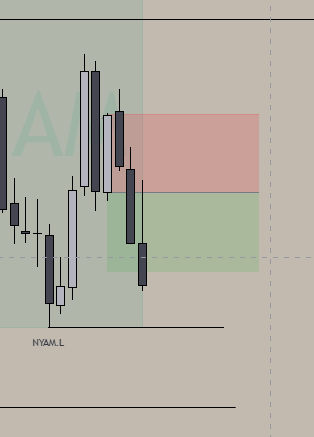
Put your own numbers in
Change anything. The bottom two lines are what matter: the win rate your ratio needs, and what each trade is worth on average at the win rate you actually have.
- Risk per trade
- $400
- Reward per trade
- $400
- Ratio
- 1 : 1
- Win rate needed to break even
- 50%
- Average per trade at your win rate
- +$120
- Winning trades to reach $2,000
- 5
At 1:1 you need to win more than half. At 65% each trade is worth about $120 on average, and five clean wins is a 50K payout.
The one time I move the stop
People ask when I go to breakeven, and whether it's at 8 points or 10 or never. It's once, and it's at 10. When price is 10 points in my favour, halfway to the target, I move the stop to entry. That's the only adjustment the trade ever gets. I don't trail it up behind price, I don't take half off at 15, and I don't let a 20-point winner become a 30-point hope. It reaches 20 and it's closed, or it comes back to entry and it's closed.
The reason for the 10-point line is that by then the trade has proven the direction. Everything after that is variance, and I'd rather give variance a free trade than a $400 one. The cost is that some trades stop out at zero that would have hit the target. I've accepted that cost; a breakeven day is a day the account is still there.
The two-trade day
Whatever the strategy, I take one or two trades a day, and which one it is depends on the first. The logic is the same in both directions.
If the first trade wins, my bias for the day was right. That's information, so I press it once: one more trade at the same size. On accounts with no consistency rule the second trade also runs for 20 points and the day ends at +$800. On my straight-to-funded accounts, which carry a 20% consistency rule, I cut the second trade at 10 points and end at +$600, so no single day gets too big against the payout total. If the second trade loses, the day is flat and I'm fine with flat.
If the first trade loses, I take one recovery trade at the same $400. Same size, not bigger; the point is to get back to zero, not to win the day back. It either recovers the loss or the day ends at −$800, and −$800 is a number I've already agreed to. Tradovate's daily loss limit is set to $800 and auto-liquidates, which means the decision to stop isn't mine to make in the moment. I get up from the desk because the platform has already closed the door.
Sizing: one mini, always
I don't size dynamically. Funded accounts get one mini, every trade, every day, whatever the balance. Evaluations get two, because the eval has a target to hit inside a window and I'll take the extra variance there. That's the entire sizing model.
The benefit isn't the risk number itself; it's that I never have to compute it. Twenty points is a distance I can see on a chart instantly, and one mini turns that distance into a dollar figure I already know. When you're scalping, the seconds you'd spend on a position-size calculator are the seconds the entry is available. Fixed size removes the calculator from the trade.
- Funded1 mini, 20-point stop, 20-point target$400 risk, $400 reward, breakeven at +10.
- Evaluation2 minis, same stop and target$800 risk. Often one mini closed at 1:1 and the second left to run, because passing is a race and the funded account is not.
- Second tradeSame size as the firstNever bigger after a loss. Doubling to recover is how a −$400 day becomes a blown account.
- Not thisSizing up because the balance grewThe drawdown didn't grow with it. On most prop accounts the room under you is the same $2,000 on day one and day sixty.
Starting out: what I tell people in the Discord
Start at one mini and see how it feels. If a $400 stop makes you move it, or makes you skip the second trade you should have taken, size down to micros and run exactly the same rules at $40. The rules matter more than the size, and micros let you learn the rules cheaply. What I'd push back on is the opposite instinct: starting at two or three minis because the evaluation "needs" to be passed fast. It doesn't, and the account you blow trying is the one you paid for.
And whatever your strategy, borrow the day structure even if you don't borrow the ratio. One trade; if it wins, one more; if it loses, one recovery; then stop. It works at 1:2 and 1:3 as well as at 1:1, because it isn't about the ratio. It's about not being at the desk for trade number five.
The questions I get, answered once
- "Why not risk 1% like everyone says?"Because 1% of the balance isn't the number that kills youOn a 50K account, 1% is $500, and the drawdown is $2,000. Four losses. Risk on a prop account should be sized against the drawdown, not the balance. $400 is 20% of my room, which is the most I'm willing to hand back on one trade.
- "Is 1:2 with 1% better than 1:1 with 2%?"Only if your 1:2 win rate is above 33% and you know itPut both into the calculator above with your real win rates. Most people discover their 1:2 win rate is a guess and their 1:1 win rate is a number. Trade the number.
- "$400 risk, so $800 win. How did you make $2,000?"Across days, not in one$400 a day for five days. The screenshots that look like one big win are usually five accounts taking the same $400 at once through a copier. Same 20 points.
- "Should I go breakeven at 1R and hold a runner for 2–3R?"Pick one and measure itHolding a runner turns some 1R wins into zeros; you're trading win rate for size. That's fine if the numbers work. What doesn't work is deciding per trade. I take the 20 and go home because I've measured it; measure yours.
- "I use 1:1.1 so the extra covers commissions. Good?"Fine, and honestCommissions on a mini round trip are a few dollars against $400. Either budget them into the target like you do, or just know your real expectancy is a little under the clean number. Both are fine. Pretending they're zero isn't.
- "Risk $400 per trade or $400 per day?"Both, and they're different numbers$400 per trade, $800 per day. Per-trade risk sets your size; per-day risk sets your lockout. Set the lockout in the platform, not in your head.
- "After a loss, same lots or bigger?"SameThe recovery trade is at $400 because the goal is zero, not revenge. If it loses too, the day is over at −$800 and the account is still alive tomorrow.
- "Is one 1:1 setup enough for years?"It has been so farAn edge in direction on NQ doesn't decay because the target is small; if anything the small target is what makes it robust. What decays is discipline around it, and that's what the day structure protects.
- "What's your win rate, honestly?"60–70% in an average monthMy best month was 95%, which I'd call unrealistic even though I did it. Plan around 60. At 60 and 1:1, every trade is worth about $80 on average, and five green days is still a payout.
The 20 points only work if the direction is right. How I decide the direction each morning is its own guide.
Read: determining daily biasThe whole thing on one card
- Instrument
- NQ, one mini funded, two on evals
- Stop and target
- 20 points each, $400 either way on a mini
- Ratio
- 1:1; breakeven at +10, no trailing, no partials on funded
- Trades per day
- one, then one more: press a win, recover a loss, stop
- Day outcomes
- +$800 (or +$600 with a 20% rule), flat, or −$800
- Lockout
- $800 daily loss, auto-liquidate in Tradovate
- Win rate
- 60–70% average; the ratio needs 50%
- Why
- five $400 days is a payout, and 20 points is a fraction of NQ's day
Compare the firms first
The $2,000 drawdown, the payout caps and the consistency rules in this guide differ from firm to firm. I keep an honest side-by-side of the four I trade, cons included.
Same code, ABHI, works at every firm on that page.
This is how I trade, current as of September 2026, written for people who ask; it is not a recommendation for anyone else's account. Contract values are CME specifications for NQ and MNQ and can change. Win rates are my own and vary by month. Drawdown, payout and consistency figures are typical 50K prop-firm terms and differ by firm and plan; check your dashboard. Trading futures involves substantial risk of loss and past performance does not indicate future results.