Prop firms · Apex
How I locked a $7,500 payout on Apex — my exact rules
It wasn't luck. It was probabilities and rules. Here's the whole run, stage by stage Apex's rules, and the tighter ones I put on myself.
Want to run these exact rules on your own account? You can get funded with Apex here — use code ABHI for up to 90% off your evaluation.
The whole run, end to end
The one idea this whole guide runs on
Most people treat trading like gambling one big trade, one big feeling, hope it works. I treat it like a numbers game. A repeatable edge, taken the same way over and over, with hard rules that make blowing up almost impossible.
The $7,500 didn't come from a hero trade. It came from stacking small, boring, rule-bound wins until the payouts added up. If you follow the structure below, there's nothing magic here just discipline applied to a known set of numbers.
But before any of it makes sense, you have to meet the thing that decides everything.
The run, stage by stage
Seven stages, in the order they actually happen. The firm's rules are fixed. Mine sit inside them, deliberately tighter.
-
01
Before you risk a dollar
Know which phase you're in
This is where most people trip.
Apex has two phases: the evaluation and the funded account. You have to understand both before you risk a dollar, because the rules — and how I attack them — are completely different.
The evaluation is a test with a fee attached. The funded account is where the profit is real, the payouts are real, and so is the risk of losing it. The trailing drawdown runs on both.
- Phase 1 — Evaluation
- Pass a profit target
- Phase 2 — Funded
- Real money, real payouts
- Trailing drawdown
- Applies to both
-
02
The evaluation
Be aggressive — on purpose
The only thing at stake is the eval fee.
The eval is the one place I let myself push. I risk anywhere from $800 to $1,000 per trade to punch through the $3,000 target fast.
Even here the trailing drawdown keeps me honest I can't just spray risk, because one or two bad trades put me against the floor. Aggressive, but never reckless. The goal is to pass cleanly and get to the funded account where it actually counts.
- Profit target to pass
- $3,000
- Drawdown room
- ~$2,000
- Daily loss limit
- $1,000
- My risk per trade
- $800–$1,000
-
03
Funded, day one
The aggression switches off
Different phase, different rules.
The base trade never changes. One contract. A 20 take-profit / 20 stop-loss. A clean 1:1. Same setup, same size, every time. No sizing up to "make it back," no going bigger because I feel confident. Sameness is the whole point — it keeps the math predictable and my head quiet.
The daily plan is just as dull. Risk about $400 a day to make $400–$800. Small, consistent, forgettable days. That's the machine.
- Contracts
- 1
- Take profit / stop loss
- 20 / 20 (1:1)
- Risk per day
- ~$400
- Target per day
- $400–$800
-
04
Every funded day
Four rules, non-negotiable
My guardrail sits long before Apex's cliff.
Mindset gets you started; rules keep you alive when your mindset cracks and it will. These are mechanical and tighter than anything Apex forces on me. That's the point.
- Rule 1 Max daily risk is $800 That's my hard ceiling for the day. Full stop.
- Rule 2 Two losing trades in a row and I'm done Two losses ($800) closes the platform for the day. No "one more to get it back." Revenge trading is how a small red day becomes a blown account.
- Rule 3 I stop when I hit $600–$800 for the day Once I've banked a solid green day, I walk. Giving profits back is a payout-killer. Banking and leaving is a skill, so I made it a rule instead of relying on willpower in the moment.
- Rule 4 More than ~6 trades and I shut it down My trade count isn't fixed — it depends on how fast I reach my target. But past six trades is my tell that I'm forcing it, not trading my edge. So I quit for the day, win or lose.
The faint line is how far a day could run. The solid part is the only stretch of it I use. Keeping the band that narrow is what makes a catastrophic day structurally hard to have.  Watch on YouTubeThe full walkthrough, trade by tradePrefer to see it in action? Watch these exact rules play out on a live account.
-
05
Weeks 1 to 3
Two gears to the line
I don't grind at one speed. I shift.
Gear 1 — week one, build the cushion. The goal is simple: get to +$2,000. Same daily rules max $800 loss, stop at $600–$800 profit and I let the good days do the work. Getting up $2,000 early builds the buffer that makes everything after it low-stress.
Gear 2 — the grind, bank the rest. After I'm +$2,000, I dial back to about $400 of risk a day and grind out the remaining $1,600. Usually around 6–7 days. Smaller, calmer, +$400-ish days. The hard part is done; now I'm protecting the lead and inching to the line. The $800 daily loss cap still stands as the backstop.
One full cycle — steep first week, gentle grind after, a deliberate cushion above the threshold. The withdrawal drops the balance and the same shape starts again. -
06
Before the request button
Apex's three gates
Trading well isn't enough. You have to qualify.
These apply to the intraday trailing accounts I used other account types differ, so confirm the rules on yours. People trade perfectly and then get blocked at the request screen because they ignored one of these. Don't be them.
- Gate 1 Five qualifying winning days Each one needs a minimum of $200 in profit. A $199 day doesn't count clear $200 or it isn't a qualifying day. ≥ $200 × 5 days
- Gate 2 Balance above the safety net On my account that line is $52,600. I don't request the second I touch it I build a small cushion above it so I'm never withdrawing right on the edge. $52,600 · I aim for ~$53,600
- Gate 3 The 50% consistency rule No single winning day can be 50% or more of your total profit since your last payout. This is exactly why I keep daily wins in a similar range instead of swinging for one hero day. Funded accounts only — not the evaluation
That last line explains the whole two-speed approach: the consistency rule doesn't exist in the eval, so I can be aggressive there (stage 02) and flip to balanced, boring daily wins the moment I'm funded.
-
07
Payout, then again
$1,500 at a time
Five cycles is the whole story.
Once I've cleared the $52,600 threshold and built my cushion (around $53,600), I withdraw $1,500.
Then and this matters for every payout after the first, I drop to $400 of risk per day and stay there. Once the account is proven and paying, there's no reason to be aggressive. I protect the golden goose and let the payouts stack.
Payout 1 — $1,500$3,000$4,500$6,000$7,500Repeat the cycle, and $1,500 at a time becomes $7,500. No secret setup the same loop, run with discipline.
Proof it actually pays
The most common doubt with any prop firm is simple: will they actually send the money? Fair question so here's a real payout from Apex landing in my account, not a screenshot from someone else's course.
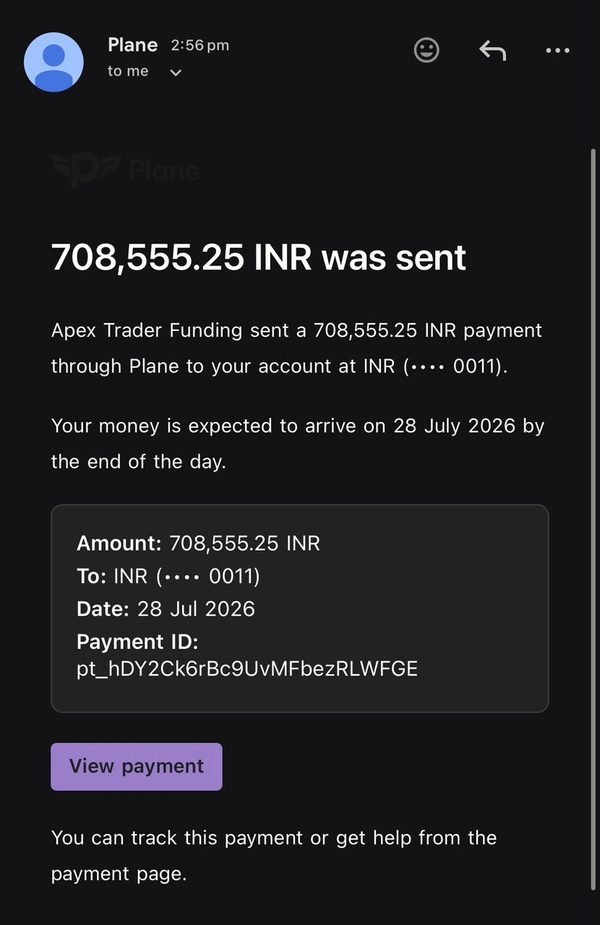
If you're in India, here's the part that worried me too: getting the money out. It was a non-issue. The payout came through Plane and dropped directly into my regular savings account at a private Indian bank no business account needed, no blocks, no back-and-forth. It just arrived on the date they said it would. (Keep your own records for tax season that part's on you.)
So the money is real, and pulling it into an Indian bank is genuinely straightforward. The only thing standing between you and a payout is running the rules above without breaking them.
The mindset that holds it all together
The rules are the skeleton. This is the part that keeps you actually following them.
Think in probabilities, not trades. A single 20/20 trade means nothing it's a coin flip on any given day. The edge only shows up across a sample. When you stop caring about any one trade and start caring about running your process 100 times, the pressure disappears and the discipline gets easy.
The account is the asset protect it above all. The trailing drawdown means one undisciplined day can erase weeks. So the account itself is worth more than any single trade's potential profit. Trading less aggressively is how you keep the thing that pays you.
The stop is the edge. Not the entry the stop. Being able to close the platform after two losses, or after banking a green day, is the rarest skill in trading. Anyone can trade when it's flowing. Payouts are won by how you behave when you're down or when greed whispers "one more."
Boredom is a feature. The best days are unremarkable: a couple of clean trades, target hit, platform closed. If a day feels exciting, I'm probably breaking a rule. Aim for boring. Boring is what gets paid.
Lock in
That's every rule I used Apex's structure and my own guardrails to turn a funded account into $7,500 in real payouts. None of it requires talent. It requires running a simple loop without breaking your own rules.
If you're ready to do the same, the first step is getting funded:
Start your own payout journey
Enter ABHI at checkout — that's what unlocks up to 90% off your evaluation. If you buy without it, the discount doesn't apply and the sale isn't credited to me. Apex discounts evals often, so grab it while it's cheap.
Follow the rules. Think in probabilities. Be boring. Get paid.
Abhinav
This is my personal experience, not financial advice. Trading futures carries risk, including loss of evaluation fees. Apex's rules and thresholds can change — always confirm the current profit targets, drawdown and payout requirements in your own Apex dashboard before trading.