Getting started · Start from zero
Your first 20 points
One real trade from my journal, slowed down until every piece makes sense — what I saw, what I risked, what it paid, and the three messy years it took to make it this boring.
You clicked "start from zero", so I'm not going to hand you a glossary. Definitions don't tell you what this actually is. One real evening at my desk does. This is 15 May 2026, exactly as it happened — and by the end of it you'll understand contracts, points, stops and funded accounts without ever feeling like you studied them.
The whole evening, end to end
Seven in the evening, India
New York wakes up at 7 pm my time. That's the strange privilege of trading US futures from India — my "market morning" starts after dinner. Screens on, one chart open. Not fifty currency pairs, not a watchlist. One chart: NQ.
NQ is the futures contract for the Nasdaq-100 — the index that holds the big US tech names. A futures contract is just an agreement to buy or sell at a set price later, but nobody at my desk is waiting for "later": you trade the price of the contract itself, up or down, and you're out again in minutes. If you want the textbook version, it's here — but honestly, the only numbers you need for this story are these three.
$5per contract
A tick is the smallest step NQ can take — 0.25 of a point. Price never moves smoother than this. Every tick is $5 for or against you.
Tap through the three sizes. Everything I do all evening is built from these numbers.
Hold onto that last one. Twenty points — $400 on one contract — is my stop on every single trade. Not sometimes. Every trade, decided before I enter, so the market never gets to negotiate with me after.
The read: the market walked downstairs all night
Before I look for any trade, I do the same top-down read every day. Price is fractal — the same patterns repeat on every timeframe — so I start big and zoom in. The daily was bearish. The 4-hour was bearish. The hourly: bearish. While I was asleep, Asia made lower lows and London followed. The market spent the whole night walking downstairs.
The hourly chart that evening
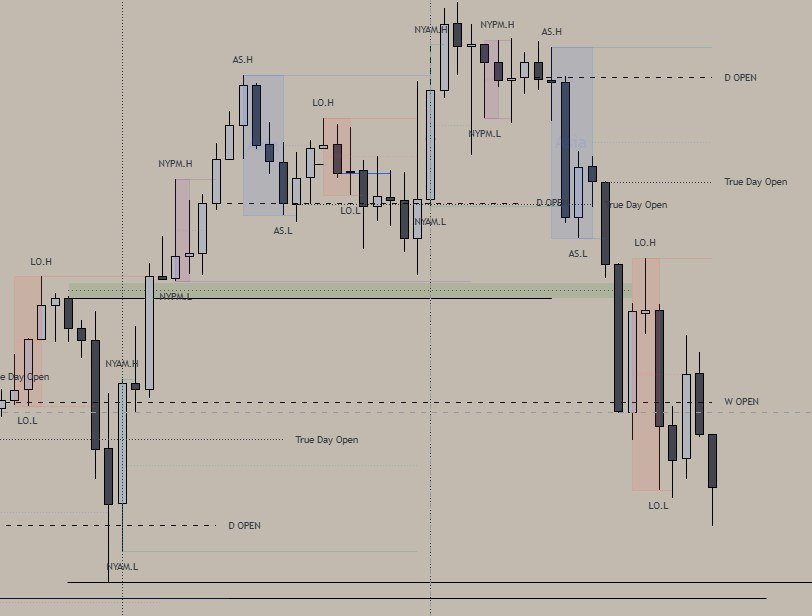
When every higher timeframe agrees like that, I want just one thing: a pullback. Markets don't move in straight lines — they step down, climb partway back up, then continue. My whole job is to wait for that climb back up into a level that matters, and short it when it rejects.
That's the entire plan, written as an if-then: if price climbs back into the level and rejects, I short toward the night's lows. If it doesn't, I do nothing. A plan you can write as an if-then is a strategy. Anything else is a feeling.
The wait
Here's where the level came from. When a new hourly candle opens, it usually flicks a wick first — a quick push the wrong way before the real move. The 8 pm candle (8 am in New York) hadn't made its top wick yet. So I sat there, doing nothing, waiting for the 9 o'clock candle to reach up and make one. That reach-up is my pullback, and on the small timeframes that wick becomes a visible shelf of orders — an order block — that price tends to reject from.
The 1-minute, just before the open
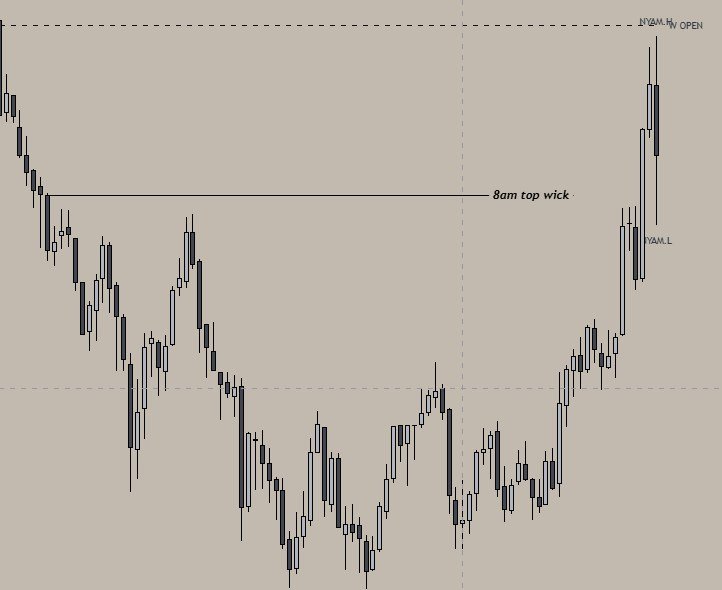
Waiting sounds easy. It's the hardest part of my day. Order blocks form everywhere — the smaller the timeframe, the more of them you'll see — and every one whispers that it's the one. Three years ago I answered every whisper. Now I answer one or two a session.
I'm still anxious. Still scared, every session — I'm handling a lot of money. The difference is that I follow rules while scared, and the anxiety has nowhere to go.
Ninety seconds of actual trading
9:30 pm my time: New York opens. The 9 o'clock candle reached up, made its top wick, and tagged the level — the "reprice" I'd been waiting almost an hour for. On the 5-minute there was an order block sitting right there. Price tapped it and rejected instantly. A small pullback on the 1-minute, and I was in — short, with the night's lows as my target.
This one didn't even make me sweat. Clean rejection, straight down to the target. In and out in minutes.
The actual entry, from my journal
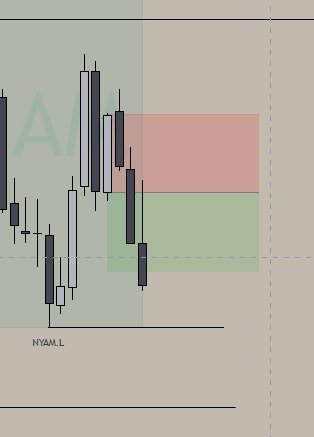
The full session — five trades that evening, screenshots and all — is in the journal, unedited.
The click you didn't see
One detail I skipped. When I clicked sell, it wasn't one trade. The same entry, the same 20-point stop and target, was mirrored across 25+ funded accounts in the same second, through a trade copier. One decision, one risk plan — copied. It's the entire reason I trade a single NQ contract with a fixed stop: one lot, no per-account math, nothing to recalculate while a scalp window is closing. (The full copier setup is its own guide.)
And here's the part most beginners in India don't know exists: none of those accounts are my own money. They're funded accounts — prop firms let you trade their capital once you pass an evaluation, a test where you prove you can make money while following risk rules. Pass it, and you keep a share of the profits. Blow it, and you've lost an eval fee, not your savings. I learned that difference the expensive way, which brings me to the honest part of this page.
The same 20 points, mirrored across every account — wins and losses alike. The copier multiplies discipline, not luck.
The three years this page is hiding
That calm little trade is the end of a story, not the beginning of one. It would be dishonest to show you the 20 points without the mess that produced them.
-
01
Forex, with a friend
Where everyone from Instagram starts
A friend and I bought a funded account from a forex prop firm instead of risking our own money — the one good instinct we had. The firm turned out to be sketchy and shut down within a month. Forex itself felt like an airplane cockpit: hundreds of pairs, pip maths on every position, spread and slippage eating every scalp.
-
02
Finding futures
One market instead of a hundred
Months of struggling later we found futures. One chart instead of fifty. No spread games, no slippage surprises. Enough volatility that a small, fixed risk could actually pay — moves that resolve in minutes, not hours. I first followed crude oil because an influencer traded it, then ES, then NQ. NQ just spoke to me — I could understand how it moved. That's the honest whole reason.
-
03
The gambling payout that almost was
The worst thing that can happen to a new trader is nearly winning
My backtests showed 70–80% win rates. Live, I kept blowing accounts — not because the analysis was bad, but because the money factor hit. Once I got within reach of a payout trading pure feel. Gambling, really. Then I blew the account just before it. That one hurt differently: I couldn't believe that gambling nearly paid me while my actual strategy sat unused. It forced the first honest reflection of my trading life.
-
04
The negative-RR crash
Risking $700 to make $200, and calling it scalping
Next mistake: a 35-point stop chasing a 10-point target, because "there's no spread, I'll just take small profits". Negative risk-reward works right up until you're not on a winning streak — then one bad week erases a month, across every account you're running. It all came crashing down. Ran that way for months before admitting the maths could never work.
-
05
The boring fix
Not a magic indicator — arithmetic
The realisation that built everything you saw above: if I'm trading rejections and price runs 20 points against me, I was simply wrong — so why hold a 35-point stop and pray? Stop goes to 20. And since good entries kept running 20–30 points my way, the target became 20 too. One contract, 20/20, 1:1, static, every trade. I'm still refining where I enter — that never stops — but the risk maths hasn't changed since.
The maths that lets me sleep
A funded account gives you a drawdown — a maximum amount you're allowed to lose before the account closes. On my accounts that's $2,000. My risk is $400 a trade, and I stop after one loss a day. Look at what that actually means:
I have to be wrong five separate times in a row, with no wins in between, to lose an account. That rarely happens — and knowing it rarely happens is what makes the waiting bearable.
My win rate over the long run has hovered around 80–85%, but notice that the system doesn't need it to. It's built for the weeks I'm cold. No single order block is certain — I can't tell you which rejection will work. I can only take every valid one, at the same fixed risk, and let the sample size do its job. No revenge trades after a loss. No "one more" after a win. The market doesn't get a vote on my numbers.
The eval isn't testing whether you can make money. It's testing whether you can follow rules while making money. Different skill.
Where this leaves you
You've now watched one full trade, and you understand more of what actually matters than most people six months in: fixed risk in dollars you chose in advance, a plan written as an if-then, someone else's capital doing the risking, and patience as the actual edge.
From here, follow whatever pulled you in. The ten-minute textbook version now has a story to hang on. The full May 15 session shows this same trade with its four siblings, including the riskier ones. And when you eventually wonder whose capital I'm trading — that's step two of the path, with my honest notes on each firm, cons included.
Everything here is free. If you ever sign up with a firm I use, code ABHI gets you a discount and keeps this site running — details live quietly on Start here.